Reference video(s) are from here https://www.urasenke.or.jp/texte/resources/#video.
History
- Devised by Ennosai in the Meiji period. The earliest existing record of this temae being done was in November 1911 by Ennosai.
- Designed ostensibly because general hygiene concerns were on the rise in Japan, and there was some concern about nomimawashi (drink and pass) of koicha.
- Some thought it was born out of the Spanish Flu epidemic, but this temae was created strictly before that epidemic.
- Kyo-datami are smaller in size than during Ennosai’s time, and consequently, so have the room sizes themselves. The nagabon originally used in this temae therefore seems unusually large and out of place in our modern sized tearooms.
Dougu
From Oiemoto:
I respect the items involved in the temae as conceived by my great grandfather, Master Ennosai. However, I do think that the size of the nagabon is a bit big, and so I have ordered something appropriate for our times from an implement dealer with whom we are closely affiliated. I believe it will be a bit smaller. As for the nagabon, when that one has been produced, it can be utilized. Or, depending on the number of guests, I consider it fine to innovatively use other forms of tray, and not the nagabon.
However, in terms of relevancy, the primary concern is to blend the tea, and no matter if the tray is a konomi-mono, it serves at the platform for making the tea, and the nagabon or such tray is not the featured item.
Therefore, no matter what, the material must be something that makes it easy to blend a bowl of koicha.
That being the case, I think that Ikkanbari lacquerware is not particularly fitting. If the tray has carving or mother-of-pearl inlay and so on, or is ornately decorated, that aspect is not especially needed for making tea, I believe.
Whatever the case, even with my own favored items, […] my intention is to favor them thinking of their ease of use in the temae.
Regarding improvisation and using your brain:
Recently I did kakufukudate using a tenchaban. For kakufukudate with a ro, instead of using a nagabon, you could (for instance) use the daienbon tray favored by Ennosai.
[…] there is a daien-bon that Ennosai designed, as well as one designed by Tantansai. Ennosai’s is larger, and Tantansai’s is a bit smaller. If the larger version is used for this ro temae, it fits in surprisingly well.
Whatever the case, while implementing creative ideas, I hope to talk to you now and again about ideas for deriving enjoyment from this temae.
Host-side
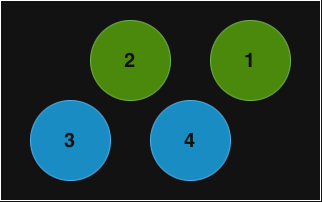
- Tea is made in the order shown above.
- One scoop of oyu for 1 → 2, another for 3 → 4.
- Then tea is kneaded 1-4, doing no-no-ji for each.
- After tray is served, teishu closes up shop, then turns out to kyakutsuki to have conversation as normal for hirademae.
Overall, this is a standard koicha temae, but with a brief addition in the middle that affects nothing before or after.
This temae would never realistically be done in a koma. If you have enough guests where kakufukudate is necessary, it would be done in a 4.5-mat room or larger.
Sequence
- (Make koicha as normal for hirademae.)
- Uchizumi nerai (ro) / nakajimai (furo).
- Sukuidashi from the chaire.
- Confirmed shown in the furo video above.
- Makes sense, very similar to Kasane-jawan.
- After o-fukukagen wa?, exit for the mizuya and walk back with the tray.
- Note: If you used your fukusa, it stays until the very end when you would usually return it to your obi after replenishing cold water.
- Hanto does not hand teishu the tray. Teishu enters the mizuya of their own accord, then returns walking out holding the tray.
- Tray should be prepared with one portion of tea in each bowl.
- (Teishu leaves the door open. Hanto closes the door behind them.)
- Hanto can close door more-or-less immediately. Just don’t rush.
- Returning to imai, make tea.
- Note: This tray will be big. Place it however it fits, including allowing it to sit past the knee line.
- Holding the tray in the air, turn all the way outside the ro (beyond kyakutsuki).
- Turn the tray on the ground migi-mawari.
- Note: For Ennosai’s silly large tray, they turn it as if it’s a hexagon (3x). Hands are not necessarily turning from corners.
- Sit facing the tray, hands on lap, until jikyaku sits in their spot with the tray.
- Return back to imai, then close shop for conversation with shokyaku, turning back out to kyakutsuki to chat.
- (Hirademae continues as normal from here)
Making tea:
- Take a scoop of oyu, and pour half into 1 → 2. Take another scoop, and do the same for 3 → 4.
- After drawing water for the four bowls, place okibishaku, not kiribishaku.
- “Because in this procedure, the koicha is blended using just that single pouring of hot water” - reason given by Oiemoto in the video.
- It does not need to be a brimming ladleful; it should be a plentiful scoop.
- After drawing water for the four bowls, place okibishaku, not kiribishaku.
- Knead one by one in 1 → 4 order.
- Left hand on top of the bowl, knead expeditiously.
- When done, make a no-no-ji, then pull out with both hands as usual.
- Gracefully transition from both hands coming out to starting the next bowl.
- Chasen goes back to usual position by the chaire once done.
Guest-side
Shokyaku takes their bowl and drinks like usual, including sorei with other guests. When shokyaku finishes drinking, they wipe the bowl, then place it heriuchi kamiza until it is time for haiken.
After teishu places out the tray:
- Second guest retrieves the tray, then brings it back to their spot.
- Without osaki-ni, each guest takes their bowl in 1 → 4 order.
- Bring bowl heriuchi.
- Pass tray herisoto to the next guest.
- As soon as you get your tea, begin drinking. Wipe bowl as usual when you finish.
- No haiken of these bowls. They are considered kazujawan.
- Leave bowl herisoto from you until everybody finishes.
- Once everybody is done, begin passing bowls down to tsume.
- Pass bowls in turn heriuchi to the guest below you.
- If the next guest is moving slowly, and there is already a bowl there, wait until the spot clears up.
In the meanwhile, shokyaku begins conversation after teishu closes shop, and second guest begins drinking.
From the tsume’s perspective:
- You finish your bowl (4), then return it to its spot on the tray.
- Then you receive 3, place it back to its spot. Repeat for 2 and 1.
- Once all bowls are returned, you stand with the nagabon, then place it by the (closed) door for the hanto to retrieve.
- Leave it facing you. Hanto will turn it when they retrieve it.
- Hanto may open the door to retrieve as soon as the tsume begins walking away.
After tsume returns to their spot, shokyaku says osaki-ni and begins haiken for the omojawan. Everything is now back to normal.